The Jobs of the Future
Table of contents
Note (September 2026): I wrote this article in February 2023, almost four years before this re-read — and before the wave of generative AI reshaped much of the world of work. I’m leaving the original text untouched below and adding my reflections at the end: how accurate were these predictions, and what changes when the conversation is no longer about YouTubers and influencers, but about whether a model can do your job?
A few days ago Remitly , an international money transfer platform whose mission — according to its website — is to help migrants keep their promise of a better life for the families they leave behind, published an article about dream jobs — or the jobs of the future.
To put together this list, they used online search data — “how to become a…” — and from that determined what people “want.” I have serious doubts about the quality of the result and what it actually means, but that’s precisely what brought me to this article and the conclusions in it.
The most visible and widely shared result on social media is a beautiful map showing the most desired profession or trade for each country. For them, if a lot of people search “how to become a doctor” online, that means — in the authors’ logic — that’s the dream job.
What catches my attention the most about this result is what it implies for the jobs of the future. So let me share my thoughts, and give you a preview: how is it possible that “influencers” or “YouTubers” are dream jobs? Will our lawyers, architects, doctors, and teachers cease to exist? Of course not.
Dream jobs and jobs of the future

While many of us dream, at some point in life, of being astronauts or race car drivers, the truth is that most people don’t invest the time and energy it takes to get there.
Many dreams are just that: dreams. You, reading this article right now — do you work in the profession or trade you studied for? Did you dream of the job, role, or profession you have today?
In my opinion, if you’re happy today with what you do, it doesn’t matter whether you dreamed of it or not. Sometimes people dream of something and prove, through dedication and effort, that some dreams really are reachable. For others, life is more a process of discovery.
In a famous talk, Steve Jobs talks about the idea of connecting the dots. If you haven’t seen it, you should. If you already have, or you’re not interested, the short version is: life finds its own way, and when you look back, everything seems to connect. There’s also a wonderful book called “The Element” by Ken Robinson, about the impact of being passionate about what we do — what looks like nonsense to some people can be someone else’s path to success.
Dreaming of something shapes the decisions we make day to day. We probably don’t end up doing what we dreamed, or not in the way we dreamed it, but dreaming about it is what led us to certain decisions — what to study, which friendships to build, which articles to read, or which courses to finish.
Our dreams evolve with us
I don’t want to go too far off track, but let me be clear: there’s nothing wrong with dreaming of being an astronaut. But believing that our childhood dream doesn’t change along with us is naive and a bit silly. The same goes for the dreams we had 2 or 3 years ago. Some of us have lived through things that change us — and not just physically, they reshape our values or our view of life.
That’s why I don’t think a dream job is something fixed. Maybe becoming a baker shows you that your real passion is making pizza, or birthday cakes. And your dream evolves along with you.
List of dream jobs
Remitly’s piece presents a list of 20 dream professions or trades that are trending now and will keep trending in the near future.
| Position | Dream job (or most searched) |
|---|---|
| 1 | Pilot |
| 2 | Writer |
| 3 | Dancer |
| 4 | YouTuber |
| 5 | Entrepreneur |
| 6 | Actor / Actress |
| 7 | Influencer |
| 8 | Programmer |
| 9 | Singer |
| 10 | Teacher |
| 11 | DJ |
| 12 | Blogger |
| 13 | Doctor |
| 14 | Professor |
| 15 | Flight attendant |
| 16 | Firefighter |
| 17 | Judge |
| 18 | Lawyer |
| 19 | Attorney |
| 20 | Psychologist |
Source: Remitly.com (accessed February 13, 2023)
Looking at the top 10, I’d highlight that the idea of being a programmer has gone from being a niche thing — often tagged as something “nerds” do — to a profession that offers stability and quality of life to those who practice it (myself included).
I admit “influencers,” “YouTubers,” and “Bloggers” fall outside my conservative list and make me uncomfortable. I see them as a means, not an end. But let’s take this one step at a time.
What about the ones missing from the list
Again, this list is clearly not the result of rigorous scientific study, and looks more like a simple bit of analysis. What strikes me is that the basic things humans need to survive don’t show up, or barely register. If this is the list of dream jobs shaping — whether we like it or not — the jobs of the future, it worries me that I don’t see trades related to:
the food industry — farming, production, and processing
construction — housing, offices, civil works like ports or highways
trade — moving goods, running ports, and negotiating deals
caring for the environment
How are we going to build the cities of the future? What are we going to consume to survive? If global well-being keeps rising, how are we going to distribute it? Does nobody want to be a politician anymore? — I’ll admit that last trade draws more contempt than love from younger generations, who have watched “the leadership contract” break down (another book worth reading: “Leaders Eat Last” by Simon Sinek).
Perks as commodities
We’re so used to certain privileges that we forget what it takes to keep them running. Could we live in a world without pilots? Sure. With some limitations and trade-offs. But could we live in a world without farmers? No question, we couldn’t. Or we’d all have to learn the trade of growing our own food.
I’m a systems and computer engineer by profession, and I’ve been a university lecturer for more than 20 years, so it excites me to see “programmers” and “teachers and professors” on the list. I’ll admit the list also has some nice surprises.
Desired jobs by country
One of the most interesting parts of Remitly’s analysis is an infographic of jobs or professions by country. This is the graphic that took over some corners of social media a few days ago.
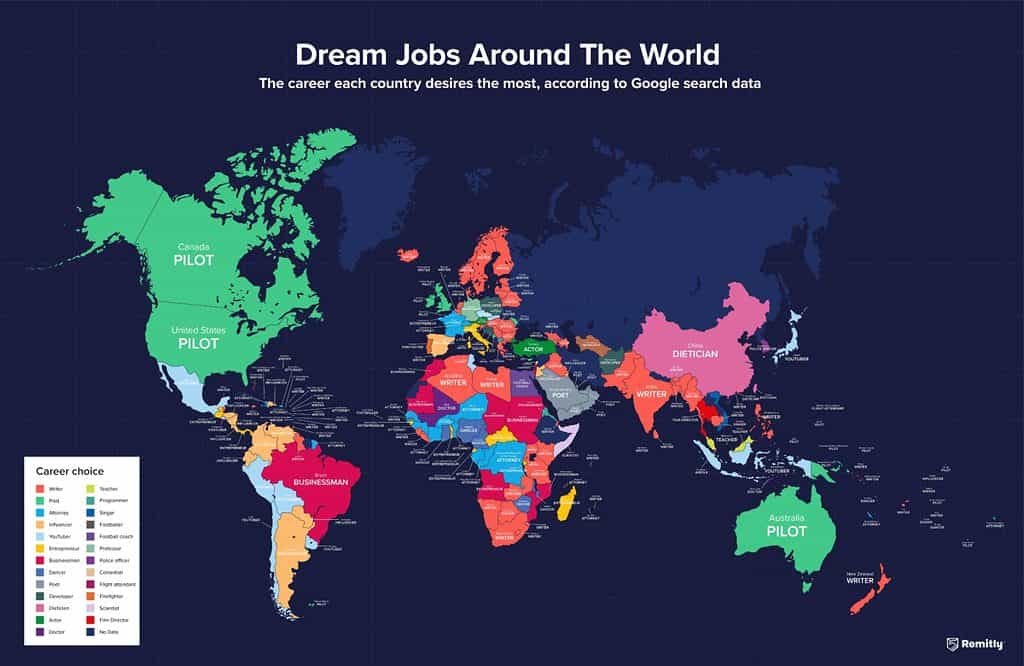
Image: Dream Jobs Around the World, by Remitly — accessed February 13, 2023
What jumps out right away is how two colors — or really, two trades — dominate Spanish-speaking countries. A light blue (sky blue, for the color connoisseurs) and a kind of pale orange (which as a kid we used to call “skin color,” even though, obviously, none of us actually had that “skin color”). Both colors stand for a single trade each: YouTuber and Influencer, respectively.
While the strong pattern across Spanish-speaking countries looks like more than a coincidence, I’ll remind you I don’t have access to the underlying sources, so I can’t confirm whether or not it’s a data quality issue.
In short, Latin Americans and Spaniards dream of being Influencers, Bloggers, and YouTubers. We could lump these trades together as “content creators” and even include Writers. But do you think they’re the same thing, or comparable?
Jobs, money, and happiness
Here’s where my hypothesis comes in: in a world in crisis, in countries where social mobility is very limited, or where job opportunities are scarce, people don’t think about a dream job — they think about whatever “seems to pay the most.” Professions as old as medicine and law have long been tied to financial well-being. Do you know anyone who studied a profession because their family or friends told them it “paid well”? This isn’t a new phenomenon.
The first thing I think of when telling apart a “dream job” from a “well-paid job” is the concept of Ikigai. Ikigai is a Japanese concept with no literal translation, roughly understood as “reason for living” or “reason to be.” Iki meaning life, and kai meaning the realization of what one hopes for. And if we’re going to talk about the jobs of the future, we need to talk about how we choose, or come to want, a trade in the first place.
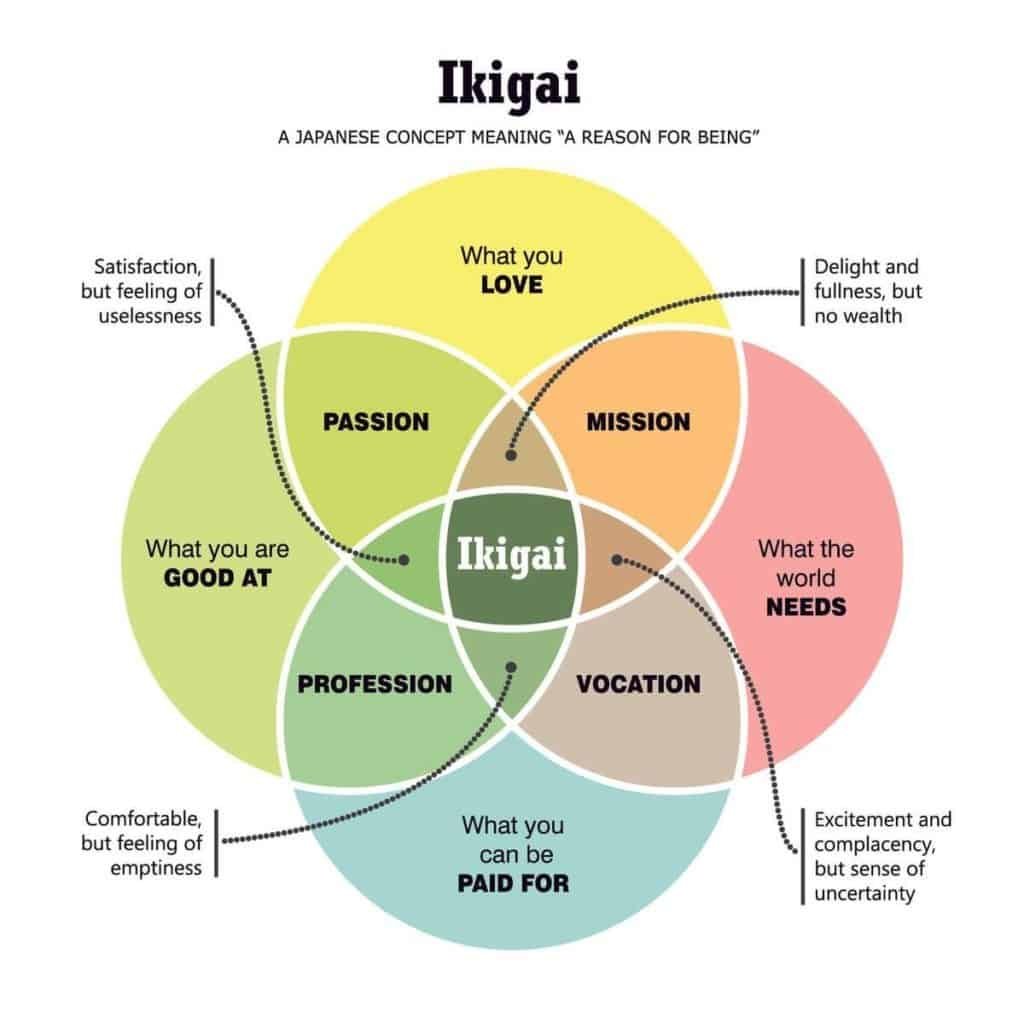
Illustration of Ikigai as a concept of convergence
The concept is often paired with self-discovery exercises designed to uncover your drive, passion, or calling. Let’s not get into whether those are the same thing or not, but here’s a talk I gave a few years ago on the topic: Pensamiento Ágil para rediseñar nuestros negocios en tiempos de crisis - YouTube .
Skills, tastes, needs, and pay
Ikigai is reached when you manage to bring together, in harmony, what you love, what the world needs, what you’re good at, and what others are willing to pay you for.
This draws a clear line between a few things:
Things people would pay you for — these depend on context, on the market, that is, on supply and demand.
Things you’re good at — no explanation needed, whether you like it or not, you’re just good at them
Things you’re passionate about
Things that make you feel connected to a higher purpose
Not all these categories are equal, and for many of us, they shift over time. As a teenager you want certain things and stand out for others; as an adult, you probably have different strengths and qualities, and some of them stick around.
The market works the same way. What’s a great business today — something you get paid well for — might stop being one in the future.
Easy, fast money: jobs of the future
Here comes my harshest criticism for those who take pride in this analysis — and I say that because I saw several videos praising countries that “have it all figured out” about what to pursue in the future. If you chase money your whole life, you’ll reach the end of your days still chasing something unreachable. I know more than one person who can only talk about money — the money they made on some deal, the money others made or lost on another. It’s sad to watch a life reduced to measuring how much money is here or there, or how much money everyone else has. It’s never enough.
When I look at the list of trades, a few catch my attention: influencer, YouTuber, and Blogger. If that’s my dream job, that’s kind of sad. It’s sad to think someone’s goal could be “influencer.” The means becomes the end.
Purpose doesn’t matter
It’s not that being an influencer, YouTuber, or blogger is bad. The problem is that, apparently, purpose doesn’t matter. I can’t imagine doing any of these trades without having found my center, my focus — my purpose. That’s a real problem, and what we’re seeing is a chase after whatever makes money, not necessarily what I actually want to do with my life.
Let me illustrate the problem I’m pointing to with an example from my own life.
I’ve been a university and business school lecturer for 20 years. It wasn’t something I had planned, but it turns out I’m good at it, and my students enjoy my classes while they learn. Some of my former students are even close friends or colleagues today.
Could I teach any subject? Do you think I’d enjoy teaching any topic to anyone, just because I like teaching?
If teaching is my passion, does that mean I can teach any subject? Have you ever had a teacher who clearly had no idea what they were talking about and brought no real experience or story to the lesson? Have you never had an overly theoretical professor who had no clue what they were teaching, but recited their notes at speed and with perfect precision?
Influencing for money, not conviction
This is where “YouTuber,” “Influencer,” or “blogger” starts to make sense. Not every influencer or YouTuber is successful, but we only really follow the ones who are famous — and therefore make more money.
We like to study and imitate success stories, but we have no idea how many people never make it. The same goes for “entrepreneurs.” We like to study Elon Musks and Steve Jobses, but we ignore or deny the reality that small and mid-sized businesses are what actually move the world, create jobs, and distribute wealth.
So instead of thinking about doing what we love, we think about becoming millionaires. And in that light, being an influencer becomes the goal in itself. Little effort (or so they think) and a lot of fame. And we create a new, lost generation who believe knowledge is unnecessary. We stop using our brains and, we become dumber . And that’s not a joke.
The real jobs of the future
I’m a blogger. Writing helps me focus my ideas, build my future projects, and set priorities. A lot of the time, writing is an exercise in introspection; other times, it helps me process or understand concepts.
But it’s not what I do for a living. And I wouldn’t call blogging my main trade. For me, it’s a channel to express my ideas.
The jobs of the future shouldn’t be the ones that only produce money and look easy. We should choose whatever we’re passionate about, whatever helps us stay focused and in flow.
Happiness, some say, shouldn’t be confused with joy — which is momentary — but with building satisfying lives where, as Ikigai suggests, the things you love, the things you’re good at, something that gives you financial well-being, and, if possible, something that changes the world (even just a tiny bit) all come together.
In my case, that’s teaching, but I don’t make my living from it directly — I get to support and facilitate other spaces through my work. But it’s the sum of everything I do, inside and outside of “what I get paid for,” that gives my life meaning.
Whether that brings a lot of well-being or very little, I’m grateful for it. If it’s too little, I try to make up for it with something else — probably temporary — and maybe that’s where “googling” how to become a blogger, an influencer, a dumbtuber, or a dumbtoker starts to make sense. I want to believe the world is more than its social media.
Looking back, almost four years later (with GenAI in the mix)
How accurate were the predictions?
Partly, more than I would have liked to admit back in 2023. The creator economy never stopped growing, and “influencer” or “YouTuber” are now formal trades, complete with agencies, contracts, and training programs. My discomfort back then was never about whether those jobs would exist — it was about whether they should be the goal. On that, I haven’t changed my mind.
What I did get wrong was my read on what counted as “safe.” In 2023 I celebrated seeing “programmers” and “teachers and professors” in the top 10, as if they were shelters from the fleeting nature of “influencer.” Ironic: those are exactly the two trades — mine, in both of its versions — that GenAI showed up to shake first.
What GenAI changed
Not long ago, in August of this year, I wrote on LinkedIn about a dilemma I still haven’t resolved as a teacher: if generative AI can hand a student a coherent essay or a case solution in seconds, what happens to learning? I cited John Sweller’s cognitive load theory there — the idea that effort, the mental cost of facing a challenge and trying to solve it, is exactly what produces lasting learning. When that effort becomes optional, do we ban AI or fold it in? I had, and still have, more questions than answers.
I bring that up here because it changes the question this article was really asking. In 2023, the discussion about “jobs of the future” was about which tasks a machine could do instead of a human — which is why my instinctive answer was to look toward the manual: farming, building, caregiving, anything that doesn’t fit inside a screen. I still think those trades are, today, better positioned than average. But it would be naive to treat them as a permanent shelter: robotics keeps advancing — slower, and with fewer headlines than GenAI, but advancing. No trade is completely safe from automation, only trades where it still takes longer to arrive.
What the classroom dilemma made me see is something else, more uncomfortable: the risk isn’t just which tasks AI takes from us, but whether we stop choosing the effortful path once a shortcut exists. That applies just as much to programming, writing, teaching — or farming, if tomorrow there’s an AI optimizing every decision in the field for you. Ikigai is still a good map, but one of its four circles — “what you can be paid for” — is being redrawn today faster than the other three combined, and that pressures everyone to take the shortcut just to stay “employable.”
I don’t have a tidy conclusion, and I’d rather not fake one. What is clear to me, re-reading this article almost four years later, is that the underlying question hasn’t changed: it was never about guessing which trade survives, but about whether we’re still willing to put in the effort — the same effort Sweller says is what makes us learn — into whatever we choose to do, shortcut available or not.