How Agile Are We? A Model for Assessing Team Maturity
Table of contents
When you work on adopting and embracing an agile mindset, part of the work you do with organizations and teams around the world includes assessing their level of “maturity.” Starting a conversation and analysis of a team’s or organization’s current state is no easy task. That’s why assessment tools exist, to help determine how agile your team really is.
But more than diagnosing against a predefined, narrow recipe, what draws me to this kind of assessment tool - and the reason I created TEMPO - is the structure it offers for starting the conversation. To me, diagnostic tools are a starting point for deeper reflection, and it’s the coach’s or consultant’s responsibility to always keep an open mind beyond that starting point.
In this article I talk about TEMPO, a tool I designed to assess the maturity of your agile team and its environment.
TEMPO: An Agile Team Maturity Assessment Tool
TEMPO is the result of several years of work. This tool consolidates what I consider the most common, key challenges in every transformation process. It’s a simple tool for assessing the current state of an agile team - no matter how big it is.
Why the Term TEMPO?
Before getting into it, I’d like to share why it’s called TEMPO. So here’s a short, condensed version of the story.
When you start a consulting engagement supporting a fairly large team - whether it’s already agile, or interested in becoming one - it’s smart to run a diagnostic. Think of it as trying to figure out what’s going on, and why.
There are several tools out there - surveys and scoring tables - built for exactly that. My team and I ended up consolidating five dimensions worth reviewing. But those dimensions had names that were hard to remember. When things get “complicated,” or loaded with too much jargon, change management processes get harder.
That’s how, during an ideation session for a new account, we sat down to talk about the problems and challenges we, as consultants, kept running into at organizations that wanted to start or validate their evolution toward an agile team.
The main conclusion: we needed to make the diagnostic, and the pillars we’d build on, easy to understand. The diagnostic is key, but it needs to connect afterward to actual work with people.
A Judgment-Free Model for Assessing Agile Teams
For anyone who knows music - or plays an instrument - the concept of tempo is just a quality of a piece of harmony or a song. It isn’t good or bad. Something with less tempo - slower - isn’t worse than something with more tempo. There’s no positive or negative connotation attached to it.
That’s how TEMPO was born: the union of the terms tied to each dimension being assessed, combined with the search for a clear analogy to a quality every team has, one that doesn’t make it better or worse than another.
A Framework-Agnostic Assessment Model for Agile Teams
TEMPO aims to validate the impact of certain factors that promote or limit agility in a team or organization. But it avoids tying itself to any one specific method or model. In other words, whether a team wants to adopt the Scrum framework, or apply Scrumban or XP (or Agile Process ), they can still use TEMPO.
The Dimensions of the TEMPO Agile Team Maturity Assessment Model
TEMPO covers the following dimensions:
- Team
- Environment
- Mechanics
- Product Vision
- Organizational Agility
The TEMPO maturity model covers most of the challenges I’ve come across in the organizations I’ve had the good fortune to work with. That said, it isn’t healthy or responsible to assume TEMPO is an all-encompassing model covering every single challenge we, as facilitators and change agents, need to face. TEMPO will help you frame the discussion and debate around a starting point in an agile evolution.
TEMPO is similar to other models, like the Agility Health Radar or Scaled Agile’s Business Agility Self-Assessment. And while the actual structure behind it is a bit more complex than what I’m presenting here, my intent is to share the general framework that gets the reflections and decisions of an agile evolution process moving.
The Team Dimension: Assessing an Agile Team’s Maturity
All the dimensions in TEMPO might carry equal weight, but without a team, there are definitely no results.
TEMPO is a collection of questions and assessments about the current state of each dimension. In this case, the state of the TEAM.
Here’s the first component, and below it, the calculator for the TEAM dimension. Answer each of the following questions on a scale from 0 to 5. Feel free to use it freely, with your teammates and your organization.
[bt_cc id=“3576”]
How Do You Interpret the Results of the Agile Team Maturity Tool?
Using a tool without the right context or knowledge can be misleading, so before you read this like you’d read a horoscope, take a second look at each question. Every answer gives you valuable information to help facilitate a deeper discussion.
What Does the TEMPO Score Mean?
I chose the word TEMPO because it relates to harmony. Tempo, in music, refers to the speed at which a piece should be played. There’s no negative connotation - just teams that are more agile (and are perceived as faster), and others that are less agile (and are perceived as slower). But there are no good or bad teams.
Here are a few tips on reading your TEMPO score:
- Score between 0 and 40 - your team can’t run if it hasn’t started walking yet. Take the time with your team to define roles and responsibilities, and work with them to build a team identity and culture. Lean on tools like the Team Charter or the Team Canvas . You should consider some formal training or coaching too.
- Score between 41 and 60 - your team has taken its first steps. Review every answer to the questionnaire, your own and your teammates’. Check in with the team on what needs work.
- Score between 61 and 80 - your team is a potential agile team. Identify what needs improving. Ask open questions, and let the team be the one to propose solutions.
- Score between 81 and 90 - well, what can I say, you have a great team. A few of the questions might still deserve a deeper debate.
- Score above 90 - write to me ! Let me set up a meeting with you and your team. I’d love to know what you’re doing, what’s working for you, and how you got there.
There’s a huge number of tools out there for analyzing an agile team’s maturity state. And honestly, they all look pretty similar. Use this tool with your team, and start a deeper conversation about the state of your team.
The Environment Dimension: Context Within the Organization
Not everything in a transformation process comes from the agile team - the cell or squad, as it’s sometimes called. So, in TEMPO’s Environment dimension, you need to consider whether the team’s structure and the constraints imposed by its environment speed up or slow down the agile evolution process. Some of the components under ENVIRONMENT include:
1. Agile Team Size
There’s a simple difference between a “working group ” and a “team.” That difference is the number of people. The more people you have, the harder - or more impossible - it is to have a real “team.” In Scrum, for example, the recommendation has always been somewhere between 3 and 9 people[ref]Honestly, Scrum, and every author who’s written about it, has given their own answer to the team-size question, but let’s say the idea is to not stray too far from the magic number 7[/ref].
2. Team Members’ Dedication
According to Scrum, an agile team member’s dedication should be total - 100% or more, XD. But not every model, and not every organization, can structure its teams that way. So here’s another element to consider.
Of course, the Environment dimension within TEMPO has more elements to consider, along with its own assessment or measurement instrument.
The Mechanics Dimension: How the Agile Team Operates
Under the mechanics dimension of an agile team, you need to assess adherence to agile “processes” and “practices.” The goal is to assess “behavior” and “good habits,” so to speak. How often does the team run self-assessment or continuous improvement cycles - the well-known retrospectives, for example? How well, and how often, do they refine requirements? What does the effort estimation and work planning process look like?
The Product Vision Dimension: What Outcome Do We Want to Achieve?
Agility isn’t about doing Scrum . A big part of what makes a good agile team, or large-scale agile teams, successful is their ability to “come up with” incremental products and services. That’s not trivial, and I’m sure many of us have worked on teams where iterations or Sprints don’t end with a hypothesis being validated, but more with “tracking progress.”
It’s worth assessing how “agile” the conception of the product or system under development actually is, and how much that conception of the product will actually benefit from an agile mindset and organization.
The Organizational Agility Dimension: Scale
This last dimension closes out the TEMPO model. Naturally, it aims to assess how agile the organization itself is. Here you look at things like architecture, compliance, DevOps, and other tools that go beyond just producing the product or outcome.
The TEMPO Model
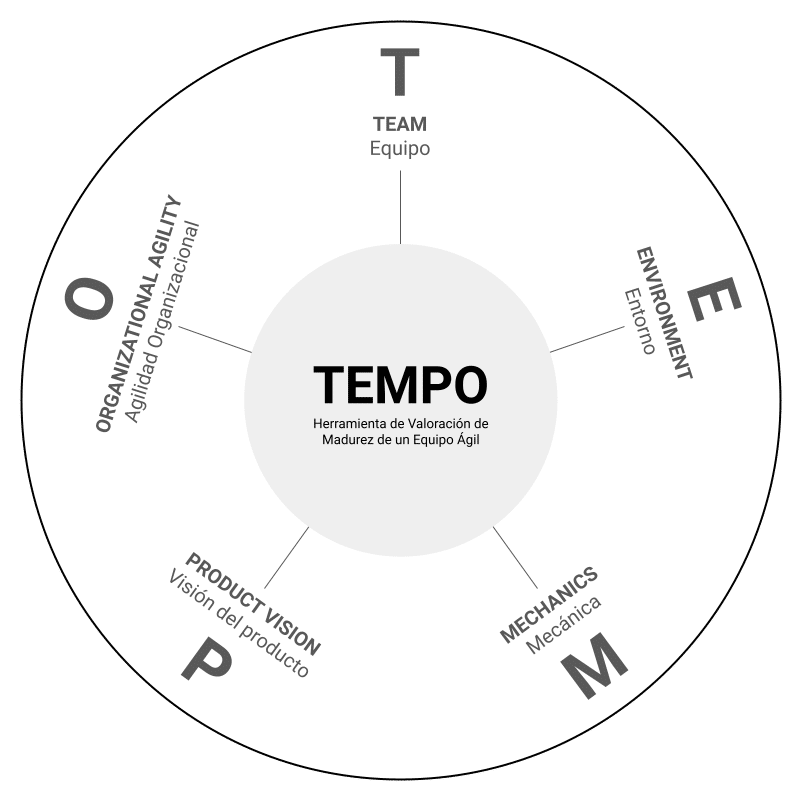
TEMPO - Agile Team and Organization Maturity Assessment Tool
Interested in TEMPO and Assessing Your Agile Team’s Maturity?
TEMPO is a full tool, and we use it on the Sperta Consulting team when we run diagnostics for teams and organizations. So don’t hesitate to reach out to us if you’re interested in the model for your organization.
A Few Notes on Agile Team Maturity Diagnostic Tools
TEMPO supports assessing the state of maturity, along with your own perception of culture and process. That said, I’m sharing the foundation of the TEAM dimension in TEMPO so you can apply it with your team. Don’t try to ask everyone about everything. It’ll help you focus the team’s debate on what matters, get them talking about what needs time, analysis, and improvement, and, of course, recognize and celebrate what’s gone well and is already working.
Share!
If you have questions that helped you deepen your analysis and define a starting (or arrival) point in a transformation process, I’d invite you to share them.