What Is DevOps?
Table of contents
You’ve probably already heard the term DevOps. But what is DevOps, really? What does it mean for work teams, and in what contexts can it be applied? Here’s the rundown.
That said, DevOps doesn’t just affect IT teams within organizations. Implementing DevOps in an organization deeply transforms how other areas interact with IT.
DevOps is also an enabler of organizational agility — I’ll explain what that means shortly. Big companies, and new players who want to stay relevant and competitive, need to understand, master, and make the most of DevOps.
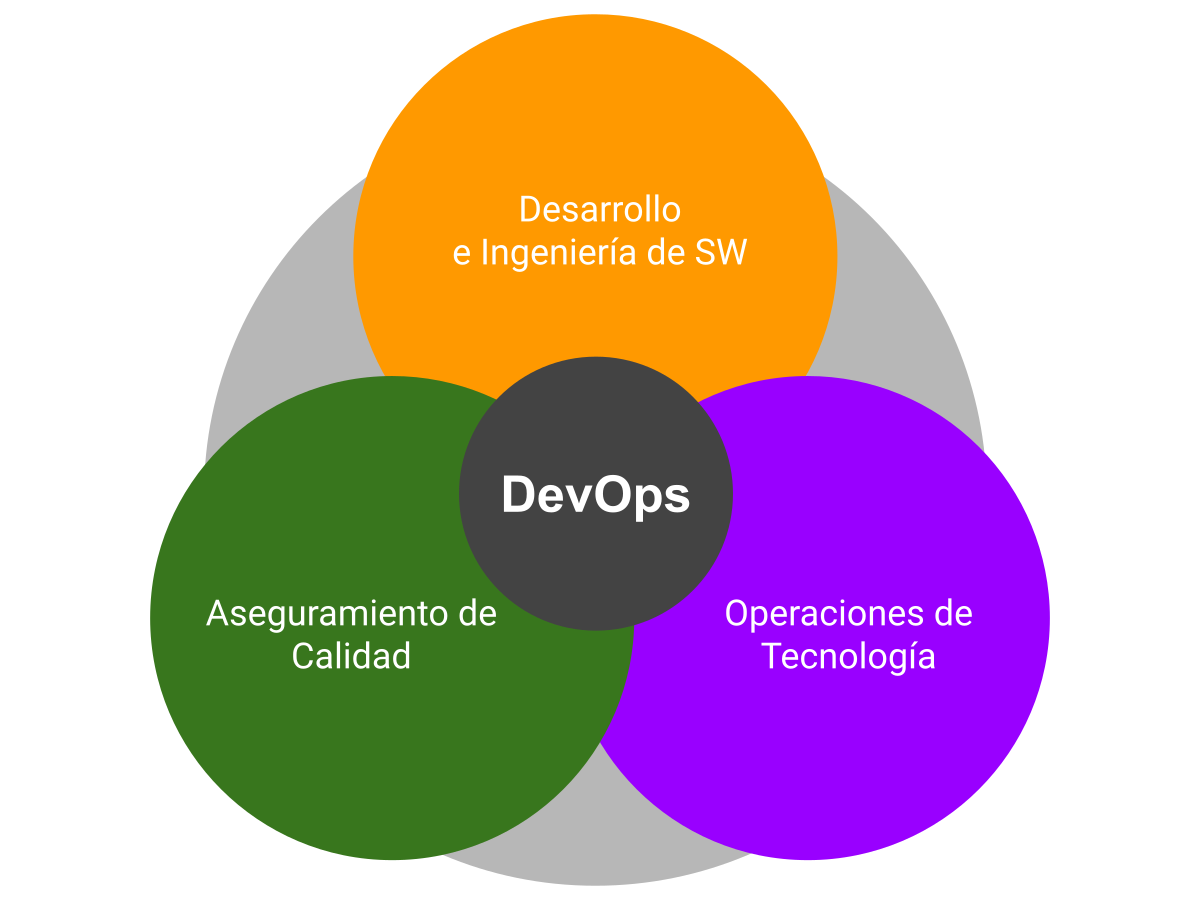
What Does the Word DevOps Mean?
DevOps comes from merging two words:
- Development, in the specific context of software, and
- Operations, of those developed software products
DevOps represents the combination of a way of thinking, a set of practices, and a set of tools. We could say:
- Way of thinking: the organization’s mindset and culture
- Practices: processes and procedures
- Tools: computer systems, automation software, and system control tools
DevOps According to Wikipedia
Paraphrasing — and improving along the way — Wikipedia’s definition of DevOps, we could say:
DevOps is an acronym referring to a software development and release methodology that calls for unifying development teams and system operations teams. DevOps emerged as a response to intermediation and hand-off models where development and operations teams act as antagonists.
In short, DevOps is:
- A way of working that impacts the collaboration between business and IT to reduce time-to-live (TTL).
- Automation-based operational processes, including:
- Deployment
- Product verification, or testing
- Release, or going into operation
- For the less happy cases — when things don’t go well — DevOps also covers the whole recovery scheme: rolling back and disaster recovery.
- New models for designing software products. There’s not much talk about this, but the truth is that, with the arrival of new technologies like containers, microservices architectures, and models like serverless, DevOps gets a boost and becomes simpler to adopt.
Is DevOps a Methodology?
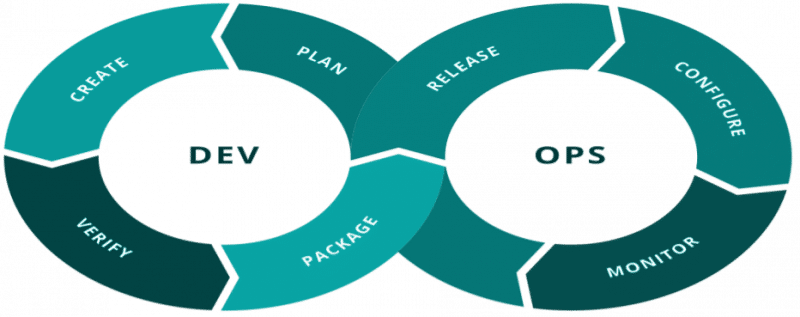
Many would say DevOps is a methodology, but the truth is its impact starts at the very process of defining a product — or ideation. In other words, for technology-driven companies, DevOps changes how we design our products.
The famous MVP of a startup that doesn’t factor in DevOps will surely just push back its market launch — and, of course, its return on investment.
Is DevOps a Culture?
No. But cultural change is part of what organizations need if they want to adopt DevOps and make the most of it.
Imagine you own a large corporation, and every year, during strategic planning, you get to weigh in with the board on a project or a new product. How frustrating would it be to end the year without ever seeing a result?
Now imagine your team isn’t just able to listen to you — it’s able to turn changes to systems in production into reality within days, hours, or even minutes. DevOps, for example, emerged out of a tech startup’s need to refresh its production product at least 10 times a day — A DAY!
Let me ask you: would having that capability on your team change the way you think about your projects and business initiatives?
Of course it would!
DevOps, DevSecOps, ITOps, and the Rest
The idea makes sense: DevOps aims to reduce the time it takes for a development team’s output to go into operation. But that raises other challenges for the organization.
DevOps
We’ve already talked about DevOps — it’s the unification of software development teams and IT operations teams.
DevSecOps
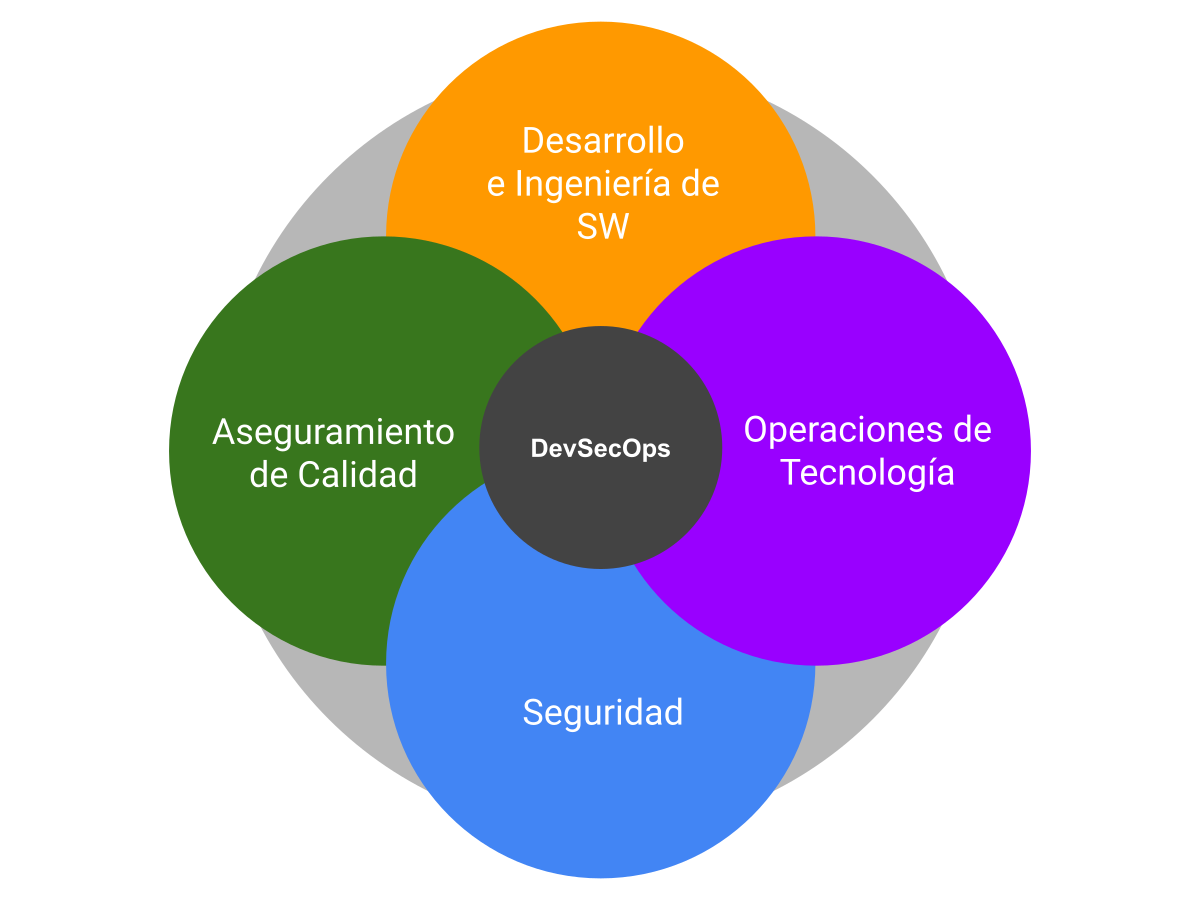
Within the context of unifying Development and Operations, the concept of security — both in the development process and in operations itself — matters more and more every day. It’s no accident we see news about cyberattacks every day, often attributed to governments.
Security can’t be treated as an afterthought, and that’s why DevSecOps, an extension of the DevOps concept, adds one more dimension: security.
ITOps, DataOps, and SysOps
As the term DevOps has taken off, other movements or perspectives have emerged with similar ideas. Here’s a quick summary of these movements:
- DataOps: the combination of the DevOps concept in industries or companies that handle large volumes of data. As a result, DataOps has a strong focus on data management and data professionals — data scientists and developers.
- SysOps: focused specifically on operating systems at scale — not just for one company, but globally. With the rise of PaaS and IaaS models — platform and infrastructure as a service — there are now groups focused specifically on operating infrastructure.
- ITOps: information technology operations. A new name for IT operations.
NoOps
This might be the most radical concept of them all. NoOps means: NO OPERATIONS. In other words, everything is 100% automated, so there’s no operations team. Somewhat risky for large companies, but very useful for small ones that, before scaling up, can access powerful technology without investing too much.
AIOps: AI in the Service of Tech Operations

If innovation is what you’re after, AIOps is at the cutting edge. Gartner predicts that the people in charge of IT operations will experience a radical shift in the years ahead. As a result, demand for technology and for new, more flexible, and more reliable services will require a transformation in IT companies’ capabilities.
The goal: use ML — machine learning — and big data technologies to strengthen IT operations.
Why Is DevOps Fundamental to Agility?
What good is having the best race car driver at your service if your car doesn’t work — or worse, if it keeps breaking down while you’re driving and you have to keep stopping?
Organizational agility is the ability to introduce changes and innovations into the business environment — or to quickly adapt to the changes others introduce.
So, since that agility depends heavily on the computer systems and technologies an organization uses to operate and interact with its customers, DevOps is key.
Imagine being part of the most dazzling Scrum team, full of talent and great ideas — capable not just of coming up with ideas, but of turning them into the most innovative, and probably most successful, products. What good is that if your organization is incapable of putting them into operation in a coordinated way alongside the rest of the organization’s existing products and services?
DevOps is a fundamental part of what SAFe calls the Continuous Delivery Pipeline — the ability to explore, integrate, and deploy solutions continuously, or very frequently.
DevOps’ Real Challenge: Operating Products in Development
What’s the real challenge behind DevOps? The real problem is that you’ll have to operate products — to enable the learning and feedback cycles that are so essential to innovation and new product development. In other words, you’re stuck weighing:
- Building a product good enough to go to market
- As cheap as possible
- As fast as possible, to make sure it’s convenient and timely
- As incomplete as needed, to let the product adapt to changing market needs
In the end, you have to find a way to live in harmony between “defining the product,” “completing the product,” and “operating the product.”
DevOps Is an Enabler for Tech-Driven Startups
How have small or early-stage companies like NuBank managed to compete with huge companies with millions of dollars in the bank? How is it possible for a startup to go from a few hundred customers to millions of customers, in what’s known as “exponential growth”?
Easy — through adopting DevOps as a way of thinking. That means incorporating:
- A cultural shift within the company to take advantage of this “always beta ” mindset.
- A design challenge for our products and services, so they can adapt unexpectedly to exponential growth — I’d recommend the book “Exponential Organizations” if this topic interests you.
- A paradigm for acquiring tech products and services built to support that growth — PaaS, or cloud services offered by Amazon, Google, and Microsoft.
DevOps Tools
There are thousands of tools solving specific needs for development or operations teams — from small integration services to complex platforms for design and automation flows.
The best tool I can share with you is the Periodic Table of DevOps Tools which, while not perfect, offers a very detailed list of tools focused on improving the flow of products from conception through operation.
The Periodic Table of DevOps Tools, by Digital.AI
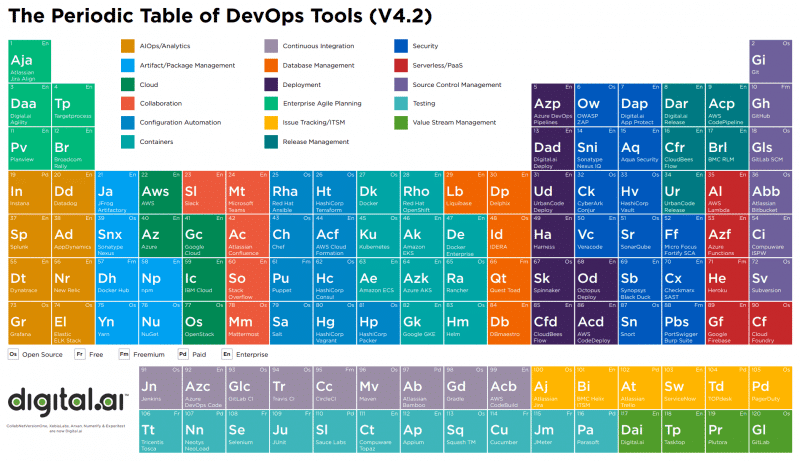
The periodic table of DevOps tools is an excellent index that serves as a reference for people just getting started. It’s ideal for identifying popular tools within the software development and delivery lifecycle — what, as I mentioned, SAFe calls the Continuous Delivery Pipeline.
This periodic table of DevOps tools was put together by experienced professionals who, according to the authors, cast more than 18K votes across more than 400 products.
I’d always invite you to check out the Periodic Table of DevOps Tools to stay up to date.